Why Proxmox VE 9.2.2 is the Smart Choice for Business Owners, IT Leaders, and Modern Infrastructure Teams
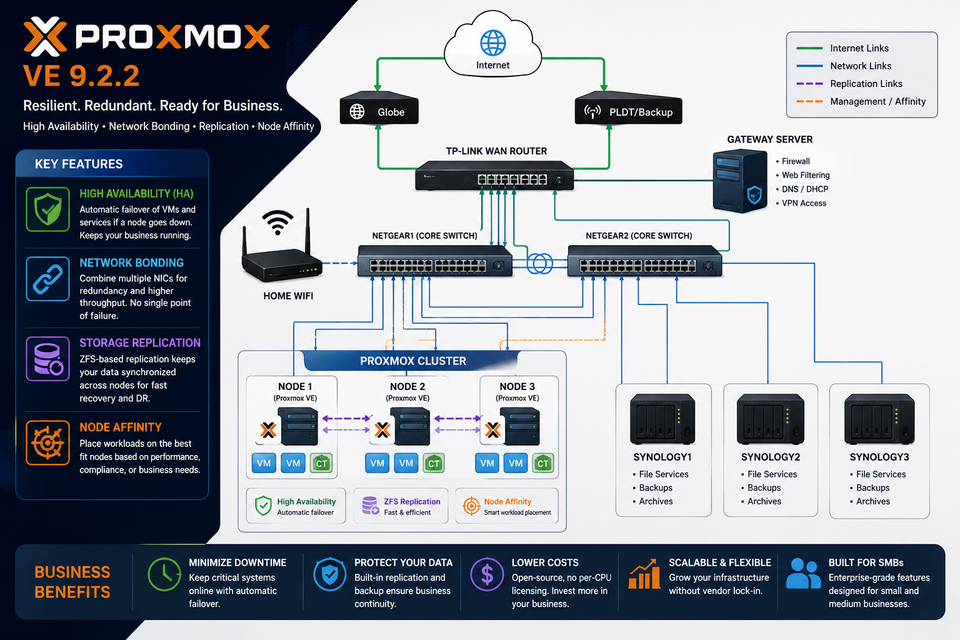
Reduce Downtime, Improve Business Continuity, and Lower Virtualization Costs Without Compromising Enterprise Features
In today's digital landscape, businesses rely heavily on IT infrastructure to support daily operations, customer services, and business growth. Whether you're running a manufacturing company, retail business, professional services firm, or managed service provider, downtime can directly impact productivity, customer satisfaction, and revenue.
For many business owners, the challenge is finding a virtualization platform that delivers enterprise-grade reliability without the high licensing costs often associated with traditional solutions.
This is where Proxmox VE 9.2.2 stands out.
With built-in features such as High Availability (HA), Network Bonding, Storage Replication, and Node Affinity, Proxmox enables organizations to build resilient, scalable, and cost-effective infrastructure using standard hardware.
What is Proxmox VE 9.2.2?
Proxmox Virtual Environment (PVE) is an open-source enterprise virtualization platform that combines:
- KVM Virtual Machines
- Linux Containers (LXC)
- Clustering
- Software Defined Storage
- Backup and Recovery
- High Availability
- Centralized Management
Unlike many commercial virtualization platforms, Proxmox provides enterprise capabilities without per-core or per-socket licensing costs.
For growing businesses, this means more budget can be invested in innovation, cybersecurity, and infrastructure improvements rather than software licensing.
High Availability: Keeping Your Business Running
Imagine your primary server suddenly fails during business hours.
Without High Availability:
❌ Critical applications go offline
❌ Employees cannot access systems
❌ Customers may experience service interruptions
❌ Revenue and productivity are impacted
With Proxmox High Availability, workloads are automatically restarted on another available node within the cluster.
Real-World Example
A business operates:
- ERP System
- File Server
- Active Directory
- Accounting Application
- Internal Web Applications
across a three-node Proxmox cluster.
If one physical server experiences hardware failure:
- Proxmox detects the failure
- HA Manager initiates recovery
- Virtual machines restart on another node
- Business operations continue with minimal disruption
Business Benefits
✔ Reduced downtime
✔ Improved business continuity
✔ Automated failover
✔ Increased customer confidence
✔ Reduced dependency on manual intervention
For small and medium-sized businesses, this provides enterprise-level protection without requiring a dedicated enterprise budget.
Network Bonding: Eliminating Single Points of Failure
Many organizations invest heavily in servers but overlook one critical component: network redundancy.
A failed network cable or switch port can cause service interruptions even when servers remain operational.
Proxmox supports Network Bonding, allowing multiple physical network interfaces to function as a single logical connection.
Advantages
Redundancy
If one network interface fails, traffic automatically continues through the remaining connection.
Increased Performance
Using LACP (802.3ad), organizations can aggregate multiple interfaces for higher throughput.
Better Cluster Reliability
Cluster communication remains stable even during network failures.
Improved Storage Replication
Dedicated bonded links can be used for:
- Replication traffic
- Backup traffic
- Cluster synchronization
The result is a more resilient infrastructure capable of supporting mission-critical workloads.
Storage Replication: Built-In Disaster Recovery
Disaster recovery is often perceived as expensive and complex.
Proxmox changes this by including Storage Replication directly within the platform.
When using ZFS storage, virtual machine data can be replicated automatically between nodes at scheduled intervals.
Only changed blocks are transferred, making replication efficient and bandwidth-friendly.
Business Benefits
✔ Faster recovery during hardware failures
✔ Improved disaster preparedness
✔ Reduced recovery time objectives (RTO)
✔ No need for expensive SAN solutions
✔ Lower infrastructure costs
For businesses that cannot justify enterprise storage arrays, Proxmox provides a practical and affordable alternative.
Node Affinity: Putting Workloads Where They Belong
Not all workloads have the same requirements.
A database server may require:
- Faster CPUs
- More RAM
- NVMe storage
while a file server may operate efficiently on standard infrastructure.
Node Affinity allows administrators to define preferred locations for specific workloads.
Example Use Cases
Database Workloads
Prioritize nodes with:
- High-performance NVMe storage
- Larger memory capacity
- Higher CPU resources
Business-Critical Applications
Ensure important systems run on preferred hardware.
Compliance Requirements
Keep regulated workloads on designated infrastructure.
Performance Optimization
Distribute workloads strategically across the cluster.
Node Affinity provides greater control over infrastructure resources while maintaining the flexibility of virtualization.
A Practical SMB Deployment Scenario
Consider a growing business with:
Infrastructure
| Component | Configuration |
|---|---|
| Cluster Nodes | 3 |
| Hypervisor | Proxmox VE 9.2.2 |
| Storage | ZFS RAID |
| Network | Bonded 10Gb |
| Replication | Every 15 Minutes |
| HA Protection | Enabled |
| Backup | Proxmox Backup Server |
What Happens During a Failure?
If Node 1 experiences hardware failure:
- Replicated data already exists on Node 2
- High Availability detects the outage
- Protected workloads restart automatically
- Business services remain available
Instead of experiencing hours of downtime, recovery occurs automatically within minutes.
Why Proxmox is a Good Alternative
Business owners increasingly expect IT investments to deliver measurable business value.
Proxmox helps achieve this through:
Lower Total Cost of Ownership
No expensive per-core licensing fees.
Improved Business Continuity
Built-in High Availability and Replication reduce operational risk.
Scalability
Grow from a small cluster to enterprise-scale environments without redesigning infrastructure.
Vendor Independence
Choose the hardware, storage, and networking vendors that best fit your business needs.
Investment Protection
Avoid vendor lock-in while maintaining enterprise functionality.
For organizations seeking long-term flexibility and cost control, this is a compelling advantage.
Final Thoughts
Proxmox VE 9.2.2 has evolved into a mature enterprise virtualization platform capable of supporting production workloads across a wide range of industries.
Its combination of:
- High Availability
- Network Bonding
- Storage Replication
- Node Affinity
- Live Migration
- Enterprise Clustering
allows organizations to build resilient infrastructure without the burden of excessive licensing costs.
For business owners, the benefits are clear:
Less downtime. Lower costs. Greater flexibility. Better business continuity.
Whether you're modernizing existing infrastructure, planning a virtualization refresh, or evaluating alternatives to traditional platforms, Proxmox VE 9.2.2 deserves a place on your shortlist.